
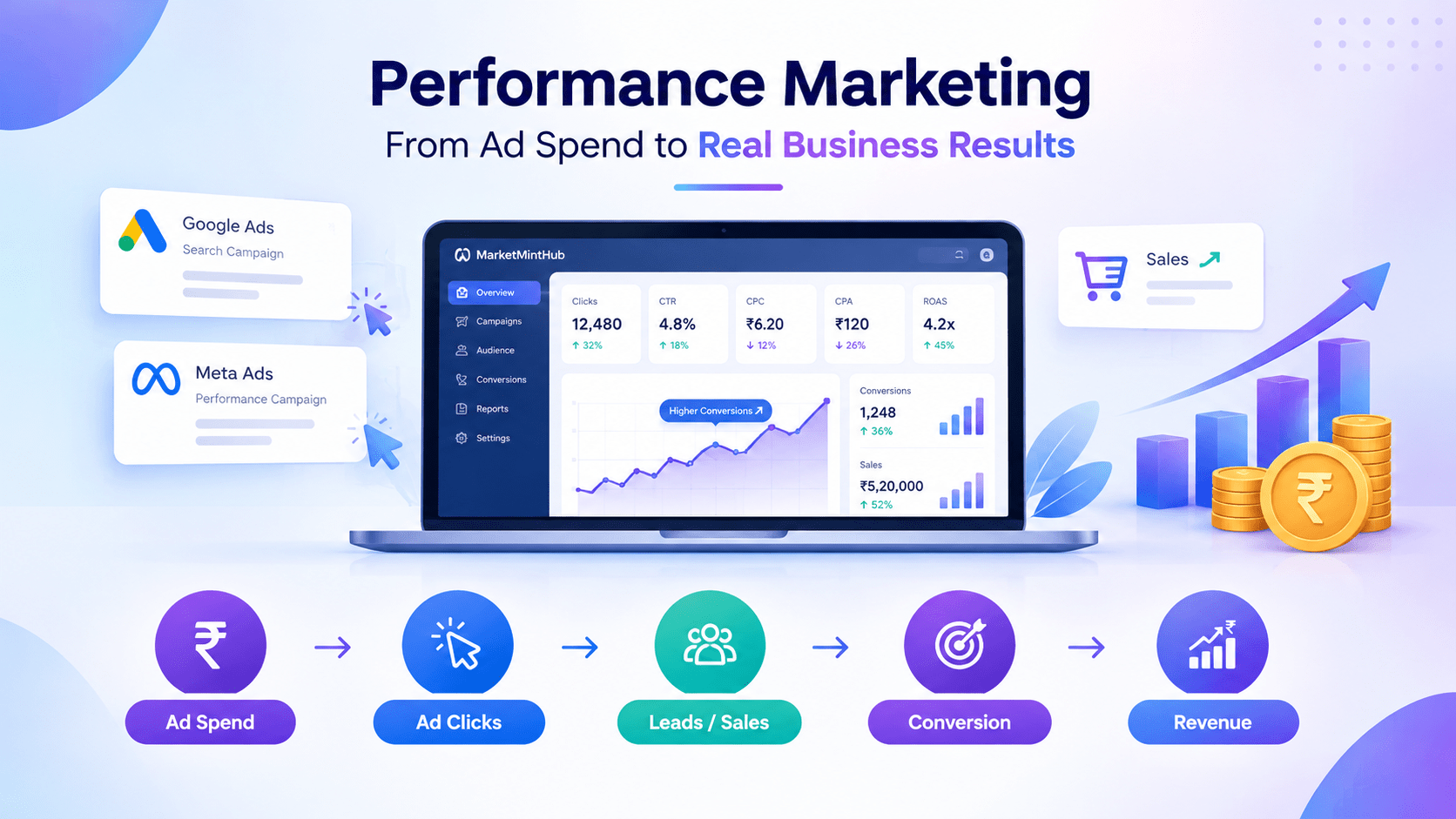
Performance Marketing: From Ad Spend to Real Business Results
A company can spend ₹10,000 on advertising and proudly say, “We got 50,000 impressions.” Sounds impressive, right? Not necessarily. If those impressions produced no leads, sales, calls, or sign-ups, the campaign may have done little more than make a dashboard look busy. That is where performance marketing becomes interesting. Instead of asking only how many people saw an ad, marketers ask a much more uncomfortable question: “What did we actually get for the money we spent?”
What Is Performance Marketing?
Performance marketing is a results-focused form of digital marketing where campaigns are measured against specific actions such as clicks, leads, sales, installs, or conversions.
Think of it like hiring a salesperson. You wouldn’t judge them only by how many people they greeted—you’d eventually want to know how many customers they brought in. Performance marketing works with a similar mindset.
The goal isn’t simply to get attention. It’s to connect ad spend → user action → measurable business result.
That doesn’t mean every campaign succeeds. Poor targeting, weak creatives, bad landing pages, or incorrect tracking can burn money very quickly.
How Does Performance Marketing Work?
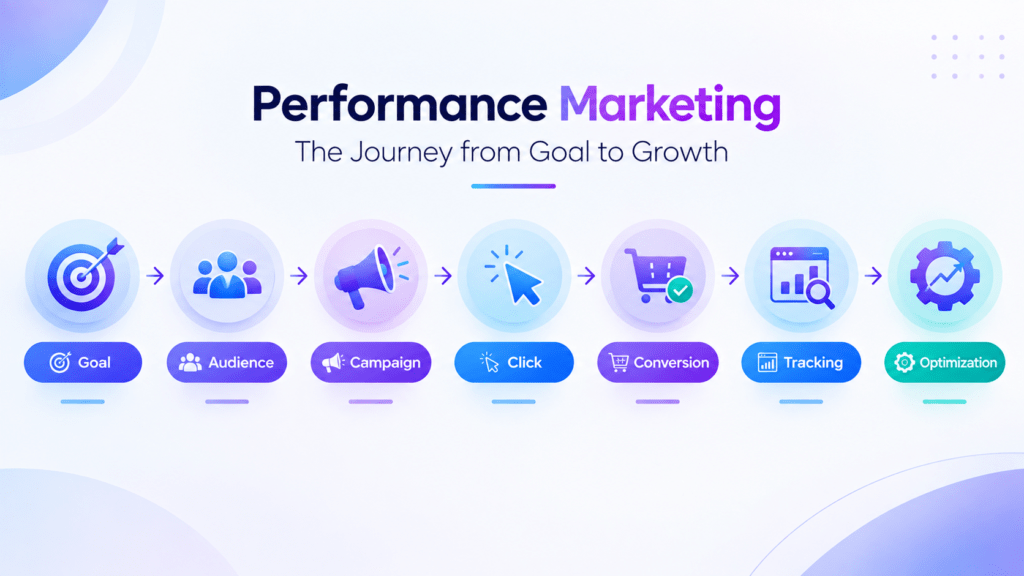
A simple performance marketing strategy follows this journey:
Goal → Audience → Campaign → Click → Conversion → Tracking → Optimization
For example, imagine an online clothing store running Google Ads for “women’s summer dresses.”
- The business chooses a sales goal.
- It targets people searching for relevant products.
- The ad sends visitors to a product or landing page.
- Conversion tracking records purchases.
- The marketer checks CPC, conversion rate, CPA, and ROAS.
- Poor-performing keywords or ads are adjusted.
- Budget moves toward campaigns producing better results.
When I first started looking at paid campaigns, one thing stood out: a campaign getting more clicks isn’t automatically the winner. Ten clicks that produce two customers can be more valuable than 100 clicks that produce nothing.
Performance Marketing Channels: Where Does It Actually Happen?
Performance marketing channels are the platforms where businesses can run measurable campaigns and connect advertising activity with specific outcomes.
Some of the most common ones are
- Google Ads: Useful for reaching people who are already searching for a product or service.
- Meta Ads: Facebook and Instagram campaigns can target audiences based on interests, behavior, demographics, and other signals.
- Affiliate Marketing: Affiliates promote products and earn when their referrals generate a defined result.
- Display Advertising: Banner and visual ads can be used for awareness, retargeting, or conversions.
- Email Marketing: Campaigns can be measured through clicks, sign-ups, purchases, and other actions.
- Influencer Marketing: Performance-based influencer campaigns can connect creator promotions with trackable conversions.
- Native Advertising: Ads are designed to fit naturally into the surrounding content and can be measured through clicks and conversions.
The smartest channel isn’t always the cheapest one. It is the one that fits the customer’s buying journey.
Performance Marketing vs. Traditional Marketing
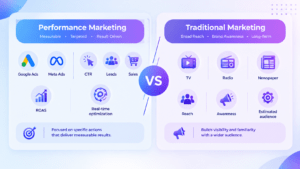
The biggest difference is how success is measured and optimized.
| Factor | Performance Marketing | Traditional Marketing |
| Main Focus | Measurable actions | Reach and awareness |
| Measurement | Clicks, leads, sales, ROAS | Reach, circulation, estimated audience |
| Payment Approach | Often tied to measurable actions/campaign results | Usually paid upfront |
| Targeting | Highly specific digital audiences | Often broader |
| Optimization | Can be changed during a campaign | Usually harder to modify quickly |
| Examples | Google Ads, Meta Ads, affiliates | TV, radio, newspapers, billboards |
That doesn’t make traditional marketing useless. A billboard can build brand familiarity in a way a conversion-focused campaign may not. The real question is what outcome does the business need right now?
Which Performance Marketing Metrics Actually Matter?
If you’re learning performance marketing metrics, don’t try to memorize numbers without understanding what they tell you.
| Metric | What It Tells You |
| CTR | How often people click after seeing the ad |
| CPC | How much each click costs |
| Conversion Rate | How many visitors take the desired action |
| CPA | Cost of acquiring one customer or conversion |
| CPL | Cost of generating one lead |
| ROAS | Revenue generated compared with ad spend |
| ROI | Overall return after considering costs |
Here’s the part beginners often miss: cheap traffic can still be expensive traffic.
Suppose Campaign A gets clicks for ₹5 but generates no customers. Campaign B gets clicks for ₹20 but consistently produces purchases. Campaign B may look worse on CPC while being far better for the business.
That’s why performance marketing examples should always connect traffic to business outcomes, not just screenshots of impressive click numbers.
What Are the Benefits of Performance Marketing?
Performance marketing gives businesses something traditional advertising often struggles to provide: ongoing feedback.
Its major advantages include:
- Measurable results: Campaign activity can be tracked.
- Budget control: Businesses can set spending limits and adjust budgets.
- Better targeting: Ads can be shown to specific audience segments.
- Faster optimization: Weak ads can be changed without waiting for an entire campaign to end.
- Data-driven decisions: Marketers can use actual campaign data instead of pure guesswork.
- Scalability: A profitable campaign can potentially receive more budget.
- Clearer attribution: Tracking can help identify where conversions came from.
But here’s the catch: better tracking doesn’t automatically create better marketing. If the offer is weak, the landing page is confusing, or the audience is wrong, excellent analytics will simply show you that the campaign is failing.
How Can Beginners Start Performance Marketing?
For anyone looking into performance marketing for beginners, start small rather than trying to master every advertising platform at once.
- Choose one measurable goal, such as generating leads or online sales.
- Define your audience based on the actual customer you want.
- Pick one suitable channel, such as Google Ads or Meta Ads.
- Set up conversion tracking before spending serious money.
- Launch, measure, test, and optimize instead of judging a campaign after a few hours.
One mistake I’ve seen beginners make is changing everything at once. New audience, new ad, new budget, new landing page—then they have no clue what actually improved the result.
What Skills Do You Need for Performance Marketing?
You don’t need to become a data scientist to start, but you do need more than the ability to press “Boost Post.”
Useful skills include:
- Google Ads and Meta Ads
- Audience research
- Copywriting
- Landing page basics
- Conversion tracking
- Google Analytics
- Data interpretation
- A/B testing
- Budget management
- Understanding the marketing funnel
- Basic SEO knowledge
The strongest marketers aren’t necessarily the people who know the most buttons inside an ad platform. They’re the ones who can look at the numbers and ask, “Why did this happen?”
Conclusion
Performance marketing isn’t just about putting money into Google Ads or Meta Ads and waiting for sales. The real game starts after the campaign goes live—when you study the clicks, conversions, costs, and customer behavior to understand what is actually working.
A campaign with thousands of clicks can still be a failure if those clicks don’t create business value. On the other hand, a smaller campaign can become highly profitable when the right audience, offer, creative, landing page, and tracking come together.
For beginners, the best way to learn performance marketing isn’t by trying to master every platform at once. Start with one channel, one measurable goal, and one campaign. Then let the data show you what deserves more budget—and what needs to be fixed.
FAQs
1. What is performance marketing in simple words?
Performance marketing means running campaigns where you can measure actions like clicks, leads, sales, or conversions. It focuses on what the campaign actually delivers, not just how many people saw it.
2. Is performance marketing the same as digital marketing?
No, performance marketing is one part of digital marketing. Digital marketing also includes SEO, content marketing, social media, email marketing, branding, and more.
3. How does performance marketing work?
It starts with a goal, reaches a specific audience, tracks their actions, and uses the data to improve results. Marketers continuously test what works and cut what doesn’t.
4. What are the main performance marketing channels?
Google Ads, Meta Ads, affiliate marketing, display advertising, email, and influencer campaigns are common channels. The best channel depends on where your target customers actually spend time.
5. Which metrics are important in performance marketing?
CTR, CPC, conversion rate, CPA, CPL, ROAS, and ROI are some of the key metrics. Together, they show whether you’re getting useful results from your advertising spend.
6. Is performance marketing good for small businesses?
Yes, it can be useful because businesses can start with a controlled budget and track campaign results. The key is choosing the right audience, offer, and conversion goal.
7. Is performance marketing a good career for beginners?
Yes, especially if you enjoy advertising, numbers, testing, and problem-solving. Learning Google Ads, Meta Ads, analytics, and conversion tracking is a practical starting point.
8. What is the biggest mistake in performance marketing?
Focusing only on clicks instead of actual business results is a common mistake. Cheap traffic means little if those visitors aren’t becoming leads, customers, or sales.