
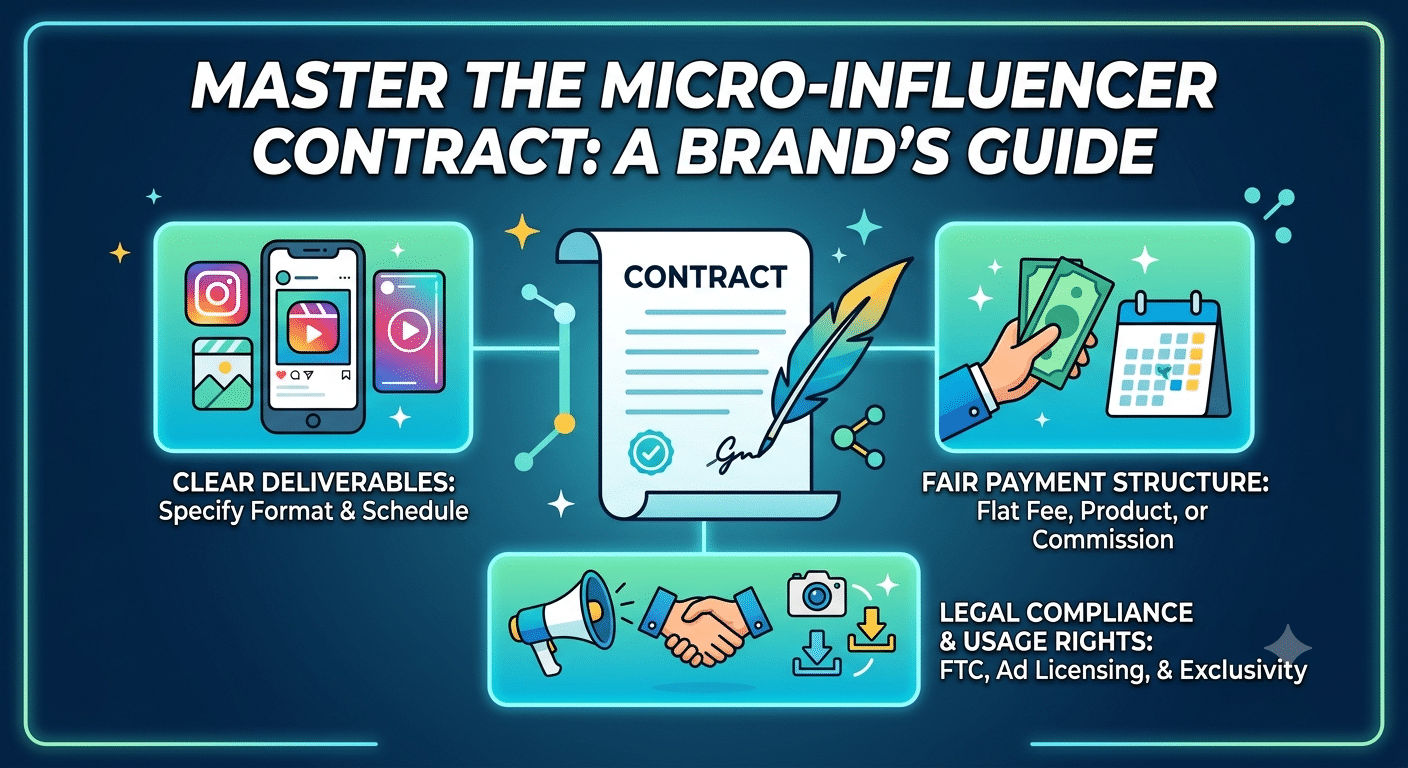
Micro-Influencer Contracts 101: What to Include Before You Pay for a Post
Introduction
You sent a micro-influencer $150 for a single Instagram post—no written agreement, just a DM and a handshake deal. Then the post never went up, or worse, it did, and now you’re locked out of ever reusing that content in your ads. Sound familiar?
This is the most common, and most avoidable, mistake brands make with micro-influencers. They skip the contract because the deal feels too small for paperwork. But “small” doesn’t mean “low-risk.” Without a clear agreement, you have no leverage if deliverables are missed. You have no rights to the content you paid for. And you have no protection if the influencer breaks FTC rules on your behalf.
The good news? A solid contract doesn’t need to be complicated or expensive to draft. In this guide, you’ll learn what to include before you pay for a single post: deliverables, payment terms, usage rights, and legal compliance.
1: What Is a Micro-Influencer Contract (And Why You Need One)
A micro-influencer contract is a written agreement between a brand and an influencer, typically one with 10,000–100,000 followers. It covers deliverables, payment, usage rights, and legal responsibilities before any content goes live.
Many brands assume contracts are only necessary for large-scale partnerships. In reality, the size of the influencer doesn’t reduce your risk—it just makes people underestimate it.
Micro vs. macro-influencer agreements differ mainly in scope:
- Macro-influencer deals often include multi-post campaigns, retainers, and formal legal review
- Micro-influencer deals are usually single-post or short-term but still carry the same legal exposure
Without a written agreement, brands risk:
- No recourse if content is never posted
- No usage rights to repurpose the content in ads
- No protection if the influencer fails to disclose the partnership properly
A simple brand influencer agreement—even a one-page document—is enough for most single-post collaborations. You only need a lawyer-drafted contract when the deal involves exclusivity clauses, long-term retainers, or six-figure budgets.
Example: A skincare brand paid a 20K-follower influencer $200 for one Reel, with no contract. The influencer posted the content but deleted it after 48 hours—well before the brand could screenshot performance data. A one-paragraph agreement stating “content must remain live for 30 days” would have prevented the entire issue.
2: Deliverables — Defining Exactly What You’re Paying For
Vague deliverables are the #1 cause of influencer partnership disputes. If your contract just says “one post,” you have no way to enforce quality, format, or timing.
Types of deliverables to specify:
- Feed posts (photo or carousel)
- Stories (how many frames, and for how long they stay up)
- Reels or TikToks (length, music/trend requirements)
- Blog mentions or YouTube integrations, if applicable
Be specific about format and platform: Here’s what a well-defined deliverable looks like compared with a vague one.
| Element | ❌ Vague | ✅ Specific |
| Platform | “Social media” | |
| Format | “A post” | 1 Reel, 15–30 seconds |
| Quantity | “Some Stories” | 3 Story frames tagging @brand |
| Tags & hashtags | “Tag us.” | Tag @brand, use #BrandName |
| Timing | “Sometime this month” | Posted between June 10–15 |
| Live duration | Not mentioned | Remains live for 30 days |
Set clear deadlines and revision terms:
- Draft submission date (before posting, if approval is required)
- Number of revision rounds included at no extra cost
- Final posting date
Example: A supplement brand specified “1 Reel (15–30 seconds), 3 Story frames tagging @brand, posted between June 10–15” instead of just “one post.” This left zero ambiguity about what the influencer owed.
3: How to Pay Micro-Influencers: Payment Terms and Structure
Paying micro-influencers fairly while protecting your budget comes down to two things: the right structure and clear terms before any content is created.
Common payment models:
- Flat fee (most common for single posts)
- Product-only (works for nano-influencers or lower-cost items)
- Commission/affiliate (percentage of sales, often combined with a smaller flat fee)
Payment schedule options:
- 100% upfront (higher trust required, common with vetted influencers)
- 50% upfront, 50% after posting (most balanced approach)
- Net-30 after posting (lower risk for brands, less appealing to influencers)
Protect your payment terms with clauses covering:
- Late delivery penalties or reduced payment
- Non-delivery refund policy
- Kill fees if the brand cancels after content is created
Example: A beauty brand structured payment as 50% upon signed agreement, 50% within 3 days of the post going live—reducing their risk of paying for content that never gets posted, without asking the influencer to work entirely on trust.
4: Usage Rights and Content Licensing
Usage rights are one of the most commonly overlooked—and most expensive to fix after the fact—parts of any influencer marketing contract terms discussion.
Two types of usage are defined:
| Usage Type | What It Means | Typical Duration |
| Organic usage | The influencer’s own post stays on their profile | 30, 60, or 90 days is standard |
| Paid usage (whitelisting) | The brand runs the influencer’s content as a paid ad, often through their ad account | Negotiated separately; typically costs more |
| Perpetual / extended licensing | Brand can use the content indefinitely | Negotiated separately; typically costs more |
Licensing duration should be spelled out clearly
Consider exclusivity clauses:
- Can the influencer promote a direct competitor during or after the campaign?
- If so, for how long after the partnership ends?
Example: A fitness apparel brand paid a flat fee assuming they could reuse the content in Facebook ads indefinitely — but the contract never granted paid usage rights. They had to renegotiate and pay an additional licensing fee after the campaign was already live.
5: Disclosure and Legal Compliance (FTC Requirements)
Every sponsored post—regardless of influencer size—must comply with FTC disclosure rules. Brands can be held liable if an influencer fails to disclose properly, so this belongs in your contract, not just a verbal reminder.
Required disclosure language:
| ✅ Acceptable | ❌ Insufficient |
| #ad | #collab (alone) |
| #sponsored | #thanks (alone) |
| Instagram/TikTok “Paid Partnership” label | #sp |
| YouTube paid promotion disclosure toggle | Disclosure buried at the end of a caption |
Disclosure must appear before the “more” cutoff on Instagram captions, not buried at the end
Platform-specific tools to require:
- Instagram/TikTok’s built-in “Paid Partnership” label
- YouTube’s paid promotion disclosure toggle
Consequences of non-compliance:
- FTC fines can apply to both the brand and the influencer
- Platforms may also flag or restrict undisclosed sponsored content
Example: A brand’s contract simply stated “please disclose the partnership appropriately.” The influencer used “#sp” — a term the FTC has specifically flagged as insufficient. Naming the exact required hashtag in the contract avoids this ambiguity entirely.
6: Approval Process and Brand Guidelines
An approval clause protects your brand voice without turning the relationship into a battle over creative control.
Define your approval process upfront:
- Will you review content before it’s posted, or only provide feedback after?
- How many rounds of revisions are included?
- What’s the turnaround time for approval (24 hours is standard)?
Brand guidelines to include in the contract or as an attachment:
- Tone and messaging do’s and don’ts
- Required hashtags, tags, and mentions
- Visual guidelines (if applicable—logo placement, filters to avoid, etc.)
Address what happens if content doesn’t meet standards:
- Right to request revisions within the agreed rounds
- Right to withhold payment if the influencer refuses reasonable revisions
Example: A brand added “one round of revisions included, additional rounds billed at $50 each” to their contract—which prevented endless back-and-forth and set clear expectations for both sides.
7: Influencer Agreement Checklist: Your Pre-Send Review
Before sending any contract, run through this influencer agreement checklist to make sure nothing critical is missing:
| Contract Element | What to Confirm |
| Deliverables | Platform, format, quantity, deadlines |
| Payment | Amount, structure, and schedule |
| Usage rights | Organic vs. paid, duration, exclusivity |
| FTC disclosure | Specific hashtag or label named |
| Approval process | Review the timeline and revision limits |
| Cancellation terms | Kill fee and non-delivery terms |
| Contact & payment details | Complete for both parties |
Common mistakes first-time brands make:
- Assuming “the influencer knows the drill” instead of specifying disclosure requirements
- Leaving usage rights out entirely, then needing to renegotiate later
- Not defining what counts as “late” delivery
Conclusion: Protect Every Partnership Before You Hit Send
A single micro-influencer contract stands between a smooth collaboration and a costly dispute. The details that seem too small to bother with cause the costliest problems when left unwritten. Usage rights, disclosure language, and payment timing are the big three.
Before your next collaboration, run through the seven areas covered here:
- Clear deliverables (no ambiguity about format, platform, or deadlines)
- A payment structure that protects both budget and timeline
- Usage rights that match how you actually plan to use the content
- FTC-compliant disclosure language, named explicitly
- A defined approval process with reasonable revision limits
- A final pre-send checklist to catch anything missed
None of this requires a lawyer or a lengthy legal document—just a clear, specific agreement that sets expectations upfront. Brands that run into trouble rarely have contracts. They assumed a DM and a handshake would be enough.
About the Author
Roshni – Content Writer, Digital Marketer, SEO Specialist, Social Media Marketer
Content writer and digital marketing strategist with more than three years of experience, passionate about delivering informative and understandable pieces on various topics like Digital Marketing, SEO, artificial intelligence, and online business growth with factual research and evidence to her readers